
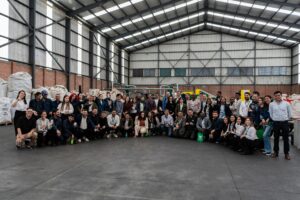
 The final day of the A2D Facility Annual Event in Bogota, Colombia, shifted the focus to a transformative pillar of the energy transition: Urban Mining. While traditional mining explores the earth, urban mining recovers strategic metals from the “waste” of our modern lives. The highlight of the day was a deep dive into Habitat Minería Urbana – Tocancipá , a zero-landfill company led by Rodrigo Sanchez and Javier Pacheco, which has emerged as Colombia’s leading platform for the circular economy. Hàbitat’s journey offers a powerful lesson in social and industrial integration because the company, originally founded by an individual from the informal sector, has scaled to eight branches across Colombia by formalizing what was once unregulated labor. By incorporating and dignifying informal workers registering over 300 individuals with tax forms and helping them establish their own companies Hàbitat has secured its position as the country’s largest waste collector, with 60% of their materials now originating from the formal sector.
 What truly sets Hàbitat apart is its commitment to environmentally friendly, dry processes that operate with no water usage and zero emissions. Their facility handles a staggering 8,600 tonnes of waste per year, treating materials from electric mobility, lithium-ion batteries, and LED lighting through a sophisticated cycle of collection, classification, storage, and recovery. The company even produces its own proprietary battery brand built on a philosophy of reuse, noting that some of the highest-quality batteries for recovery are sourced from e-cigarettes. This commitment to a “Zero Landfill” status is achieved by turning every byproduct into a resource; for instance, they dry plastics at 180°C for six hours to prepare them for reuse and utilize lead glass from panels to replace sand in construction, which reduces the thermal resistance of heating systems.
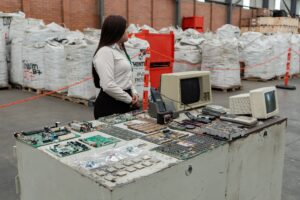
 The technical precision of this urban mining operation was on full display during the plant visit with experts Karen Safille, Jose Santamaria, and Santiago Garcia. The recovery process begins by neutralizing batteries at -15°C to ensure they are “energy empty” and have dry electrolytes before the plastics are removed. The economic value of this “urban ore” is remarkable, with high-concentration black mass reaching values of $8,500 per tonne. The mineral content recovered is often higher grade than traditional deposits, featuring concentrations of 28% Cobalt and 22% Lithium depending on the battery chemistry. The facility also targets high-value components in electronics, where one tonne of RAM chips can yield 600g of gold and a tonne of hard disks can yield 650g of platinum-group metals.
 Beyond the metals, Hàbitat’s innovation extends into sustainable building materials made from mineral byproducts. By combining water, fiber, and ground earth with salt and lime, they create construction components that minimize outdoor erosion and wear. These specialized materials even incorporate byproduct glass from LED lighting, creating a truly circular lifecycle that diverts thousands of tonnes from landfills. The facility uses a rigorous calibration process, such as calibrating copper cables for two to three days before processing batteries, to ensure the highest purity of the final cement content and recovered minerals. This in-situ assessment of waste components before laboratory testing allows for immediate classification and efficient separation of plastics and metals.
 Operating strictly within the Basel Convention framework for the transboundary movement of hazardous waste, Hàbitat ensures all strategic metal recovery is globally compliant and environmentally licensed. Colombia’s strict regulations for the final disposal of e-waste provide a solid legal foundation for these operations, which Hàbitat plans to expand with five additional facilities over the next five years. By integrating sophisticated database analysis on all battery types from small e-cigarettes to large generators with visual inspections and mineral appraisals, they have created a scalable model for urban resource management. This synthesis of high-tech recovery and social dignity provides a definitive roadmap for how the extractive sector can evolve to meet the demands of a circular, sustainable global economy.
